

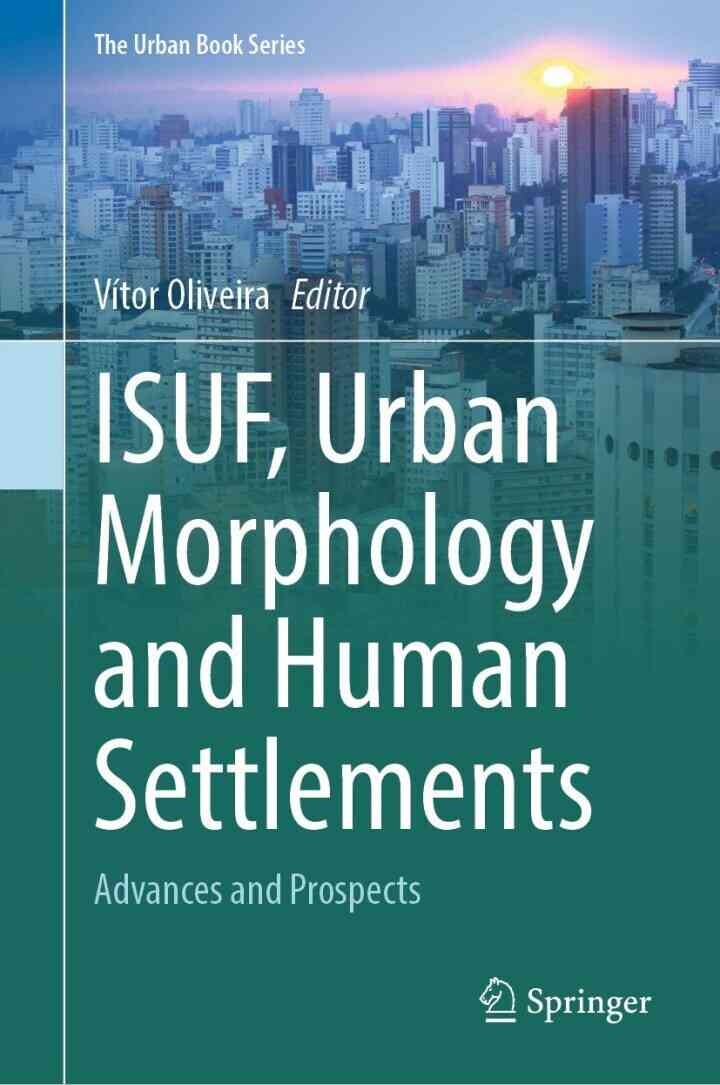
ISUF, Urban Morphology and Human Settlements: Advances and Prospects eBook
$39.99
This book offers insight into the most important scientific society on urban morphology worldwide: the International Seminar on Urban Form (ISUF).
Digital edition, delivered to your inbox within 24 hours of payment. No shipping, no delivery charge.
About this eTextbook
This book offers insight into the most important scientific society on urban morphology worldwide: the International Seminar on Urban Form (ISUF). After addressing the three-decade history of ISUF, the book analyses the present and future of this scientific society, of urban morphology, and of human settlements. This timely and fundamental reflection gathers contributions from present and past leadership of ISUF since its inception in 1994.
Over the last three decades, the urban world has undergone major changes: the urban population is now higher than the rural population; more than half of the world's population lives on a single continent—Asia, home to almost three billion people in China and India alone—so geographical imbalance is considerable; and while half of the urban population still lives in small cities of fewer than 300,000 inhabitants, the number of megacities has increased significantly. How does the physical form of cities in different parts of the world respond to these dynamics? Can cities preserve fundamental elements of humankind's urban heritage while accommodating changes driven by the main socioeconomic and environmental needs of today?
The field of urban morphology has been continuously adjusting to the essential dynamics of its object of study. While developing and strengthening its most robust theories, concepts, and methods designed after the mid-twentieth century, urban morphology has been able to integrate innovative approaches for describing and explaining the emerging dynamics and patterns of urban form—often incorporating groundbreaking technologies for data collection, analysis, modelling, and simulation. But what is the role of urban morphology in science and society today?
How effective is it in communicating a rigorous understanding of the urban landscape both to academics and researchers in other fields and to citizens in general? How successful is it in providing practitioners with relevant and useful knowledge that informs their action on cities' form and structure through spatial planning, urban design, and architecture? This book addresses these fundamental questions, offering academics, researchers, and practitioners comprehensive knowledge on human settlements, the field of urban morphology, and the role of ISUF in promoting groundbreaking morphological thought.
ISUF, Urban Morphology and Human Settlements: Advances and Prospects and published by Springer.
Publication details
- eText ISBN: 9783031581366, 3031581369
- Print ISBN: 9783031581359, 3031581350
What you receive
- A licensed digital edition of this title, supplied as PDF or EPUB. The format is set by the publisher, so email us the ISBN before ordering and we will confirm which one it is.
- Delivered to the email address on your order as a secure download link, usually within minutes and always within 24 hours of payment.
- Download links do not expire and there is no cap on re-downloads. Readable on any computer, tablet or phone, online or offline.
- This is a digital edition. Nothing is printed, packed or posted, and there is no delivery charge.
Delivery
Free on every order. This is a digital edition. Nothing is printed, packed or posted, so there is no delivery charge, no minimum order and no handling fee. The only thing added at checkout is 5% sales tax, shown on its own line before you confirm.
- Sent to the email address on your order, as a secure download link.
- Usually within a few minutes of payment clearing.
- Guaranteed within 24 hours, including weekends and holidays.
- Links do not expire and there is no cap on re-downloads.
- Delivered worldwide. No customs charge or import duty can arise.
Format. Titles are supplied as PDF or EPUB, set by the publisher. If the format matters to you, email us the eText ISBN before ordering and we will confirm which it is, normally the same business day.
Nothing arrived? Check your spam and promotions folders first. If it is not there 24 hours after payment, email us your order number and we will resend it. Full detail on the Delivery Policy.
Refunds
A digital file cannot be posted back, so there is no return process. There are situations that are refundable and situations that are not, and both are stated plainly.
Refunded in full, within 30 days of the order:
- The file is corrupt, truncated, or will not open in a reader that supports its format.
- Content is missing from the edition you were sold.
- The wrong title was delivered.
- The edition, eText ISBN, author or format does not match this page.
- You were charged twice for the same title.
- Nothing was delivered and we cannot reissue it.
Not downloaded yet? Cancel within 14 days for a full refund, no reason needed.
Not refundable: a title you downloaded and then decided you did not want, a file that does not suit your device where we did not say it would, buying the wrong edition when this page stated it correctly, and publisher printing or copy limits.
Approved refunds are issued within 2 to 5 business days to the card that paid. Full detail on the Returns & Refund Policy.
Payment
Checkout runs on Stripe. We accept Visa, Mastercard, American Express, Discover and JCB, credit or debit. That list is complete. No account is needed; guest checkout is available on every order.
What you are charged: the price on this page, plus 5% sales tax. Delivery is $0.00. There is no handling fee, no processing fee and no card surcharge. The order summary shows the full total before you confirm, and that figure is what leaves your account.
Nothing recurring. One charge per order. No subscription, no membership, no trial that converts, no saved-card auto-billing.
Security. Card numbers never reach us. Payment details are entered into fields hosted by Stripe, a PCI DSS Level 1 provider. We can see only the card brand, the last four digits and whether the payment succeeded. The whole site runs over HTTPS.
Prices are in US dollars. A card issued outside the United States is converted by your own bank at its own rate. Full detail on the Payment Policy.
About this eTextbook
This book offers insight into the most important scientific society on urban morphology worldwide: the International Seminar on Urban Form (ISUF). After addressing the three-decade history of ISUF, the book analyses the present and future of this scientific society, of urban morphology, and of human settlements. This timely and fundamental reflection gathers contributions from present and past leadership of ISUF since its inception in 1994.
Over the last three decades, the urban world has undergone major changes: the urban population is now higher than the rural population; more than half of the world’s population lives on a single continent—Asia, home to almost three billion people in China and India alone—so geographical imbalance is considerable; and while half of the urban population still lives in small cities of fewer than 300,000 inhabitants, the number of megacities has increased significantly. How does the physical form of cities in different parts of the world respond to these dynamics? Can cities preserve fundamental elements of humankind’s urban heritage while accommodating changes driven by the main socioeconomic and environmental needs of today?
The field of urban morphology has been continuously adjusting to the essential dynamics of its object of study. While developing and strengthening its most robust theories, concepts, and methods designed after the mid-twentieth century, urban morphology has been able to integrate innovative approaches for describing and explaining the emerging dynamics and patterns of urban form—often incorporating groundbreaking technologies for data collection, analysis, modelling, and simulation. But what is the role of urban morphology in science and society today?
How effective is it in communicating a rigorous understanding of the urban landscape both to academics and researchers in other fields and to citizens in general? How successful is it in providing practitioners with relevant and useful knowledge that informs their action on cities’ form and structure through spatial planning, urban design, and architecture? This book addresses these fundamental questions, offering academics, researchers, and practitioners comprehensive knowledge on human settlements, the field of urban morphology, and the role of ISUF in promoting groundbreaking morphological thought.
ISUF, Urban Morphology and Human Settlements: Advances and Prospects and published by Springer.
Publication details
- eText ISBN: 9783031581366, 3031581369
- Print ISBN: 9783031581359, 3031581350
What you receive
- A licensed digital edition of this title, supplied as PDF or EPUB. The format is set by the publisher, so email us the ISBN before ordering and we will confirm which one it is.
- Delivered to the email address on your order as a secure download link, usually within minutes and always within 24 hours of payment.
- Download links do not expire and there is no cap on re-downloads. Readable on any computer, tablet or phone, online or offline.
- This is a digital edition. Nothing is printed, packed or posted, and there is no delivery charge.
Related products

Featured Titles


Featured Titles

Featured Titles


Featured Titles

Featured Titles

Featured Titles